
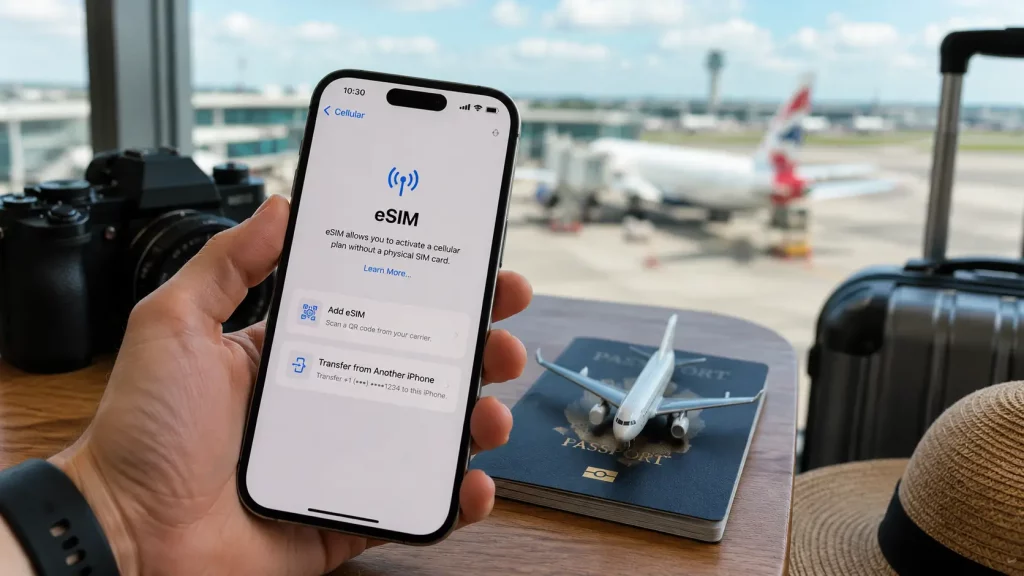
Turning on data abroad used to mean a nasty surprise on your next bill. A travel eSIM fixes that. You buy a data plan for where you’re going, install it in minutes, and keep your normal UK number for calls and texts. Here’s how it works and the one thing to check before you buy.
What is an eSIM?
An eSIM is a SIM built into your phone, so there’s no plastic card to swap. You add a plan by scanning a code or tapping through an app, and your phone can hold several eSIMs at once. For travel that means you can run a local data plan alongside your usual UK SIM, so you stay reachable on your own number while paying local rates for data.
Why an eSIM beats roaming
1. You know the price upfront. You buy a set amount of data for a set number of days, so there’s no meter running and no bill shock when you land home.
2. You keep your UK number. Your normal SIM stays active for calls and texts. The eSIM just handles data.
3. It suits multi-country trips. Regional plans cover a whole area, so one eSIM can work across several countries on the same trip without swapping anything.
4. There’s nothing to carry. No hunting for a local SIM shop at the airport and no tiny card to lose.
Which phones support eSIM?
Most phones from roughly the last five years support eSIM, including:
- iPhone from the XR and later
- Samsung Galaxy from the S20 and later, plus the Z Fold and Z Flip range
- Google Pixel from the 3a and later
If you’re not sure, check your phone’s settings for an option to add a mobile or cellular plan, or ask us and we’ll confirm it for you.
The one thing to check before you buy
Your phone must be network unlocked to use a travel eSIM. A phone still locked to a UK network won’t accept another provider’s plan.
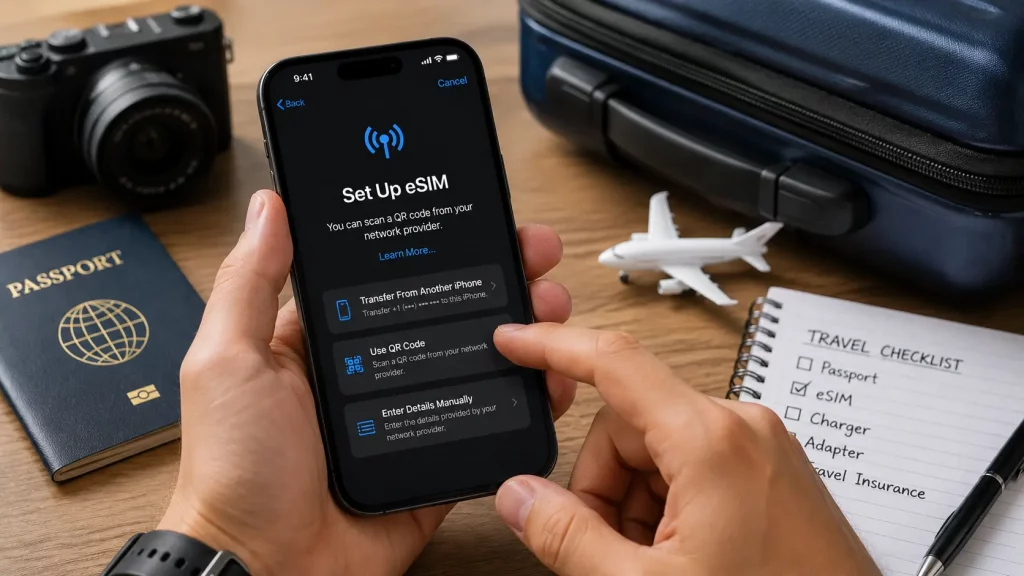
To check on an iPhone, go to Settings, then General, then About, and look for a line that says “No SIM restrictions”. On Android it’s usually under a SIM or network lock setting. If your phone is locked, don’t buy an eSIM plan until it’s sorted.
Many phones unlock for free once you’re out of contract, but it can take a few days through your network. If you’re travelling soon or your network is slow to respond, bring it to Phone Clinic and in most cases we can unlock it quickly so you’re ready to go. You can book it in or find your nearest store.
How to set up a travel eSIM
- Choose a provider. Airalo, Holafly and Nomad are among the well known travel eSIM apps. Compare coverage and price for your destination.
- Buy the plan for the country or region you’re visiting and the amount of data you expect to use.
- Install the eSIM by scanning the code the provider gives you, or through their app.
- Set your data line to the travel eSIM, and leave your UK SIM for calls and texts.
- Turn on data roaming for the eSIM only when you arrive. This sounds odd, but it just lets the travel plan connect to local networks. Your UK SIM stays on its normal settings.
Roughly what does a travel eSIM cost?
Prices change often, so treat these as a guide and check current rates in the app before you buy.
| Destination | Typical small plan | Typical larger plan |
|---|---|---|
| Europe | £3 to £5 (around 1GB, 7 days) | £8 to £15 (around 5GB, 14 days) |
| USA | £4 to £6 | £10 to £18 |
| Turkey | £3 to £5 | £8 to £14 |
| Thailand | £3 to £5 | £7 to £12 |
Compared with paying for roaming by the day, which often runs from a couple of pounds to around six pounds daily on top of your normal plan, a travel eSIM usually works out cheaper for anything more than a short trip.
Common mistakes to avoid
- Not checking your phone is unlocked. The most common reason an eSIM won’t activate.
- Buying too little data. Maps, messaging and the odd video add up. A little spare is cheaper than topping up abroad in a hurry.
- Leaving setup until you land. Install the eSIM before you travel on your home Wi-Fi, so it’s ready to switch on when you arrive.
- Forgetting to switch your data line. If data still runs on your UK SIM, you’re back to roaming charges.
What if your phone doesn’t support eSIM?
If your phone is too old for eSIM, you can still use a physical local SIM at your destination. If it’s getting on in years anyway, it may be worth repairing or upgrading before you travel so you’re not caught out. Pop into any Phone Clinic store and we’ll tell you honestly what makes sense for your phone.
FAQ
What is an eSIM and how does it work for travel?
An eSIM is a SIM built into your phone, with no card to swap. For travel you buy a local data plan, install it in minutes, and run it alongside your UK SIM so you keep your own number while paying local data rates.
Do I need to remove my UK SIM to use a travel eSIM?
No. Your UK SIM stays in the phone for calls and texts. The travel eSIM handles data, and you choose which line data uses.
How do I know if my phone is eSIM compatible?
Most iPhones from the XR, Samsung phones from the S20 and Pixels from the 3a support eSIM. Check your settings for an option to add a mobile or cellular plan, or ask us to confirm.
Does my phone need to be unlocked to use a travel eSIM?
Yes. A phone locked to a UK network won’t accept another provider’s eSIM. Check it’s unlocked before you buy a plan, and if it isn’t, we can usually unlock it quickly.
Is a travel eSIM cheaper than roaming?
For most trips, yes. You pay a fixed price for a set amount of data instead of a daily roaming charge, which usually works out cheaper for anything longer than a day or two.