
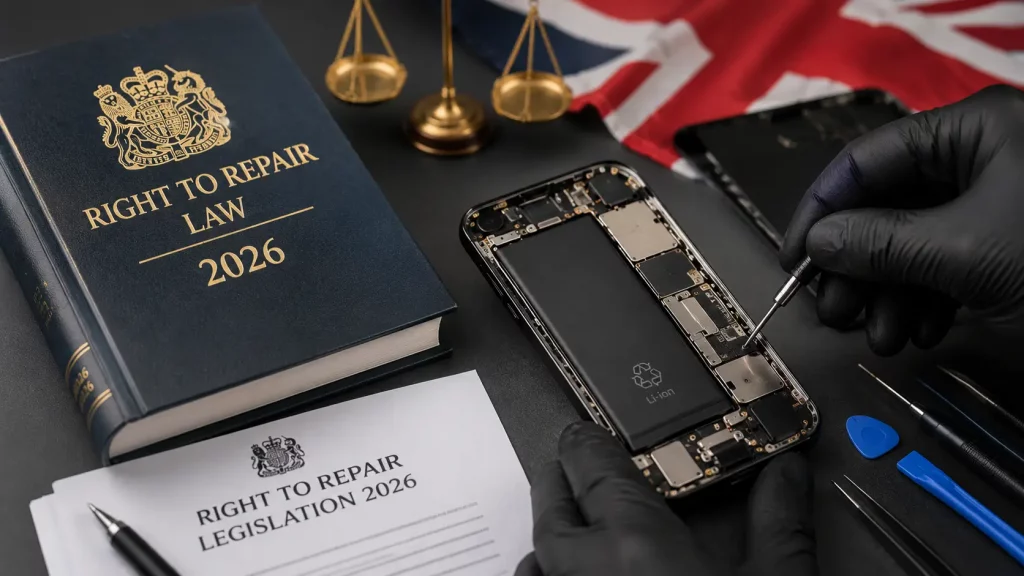
For years, phone manufacturers made it difficult to repair your own device or take it to an independent shop. Parts were restricted. Software locked out third party components. Repair manuals were kept behind closed doors. If something broke, the manufacturer wanted you to come to them or buy a new phone.
That is changing. In 2025 and 2026, both the UK and the EU introduced laws that extend right to repair protections to smartphones and tablets for the first time. These rules force manufacturers to supply parts, share repair information, and stop using software tricks to block independent repairs.
But the laws are not perfect. There are gaps, loopholes, and things the legislation does not cover. This guide explains what actually changed, what it means for you as a phone owner in the UK, and what still needs fixing.
What the UK Law Says
The UK updated its Ecodesign and Energy Labelling Regulations to cover smartphones and tablets starting 20 June 2025. This was a significant expansion. The original UK right to repair rules from 2021 only covered household appliances like washing machines, dishwashers, and fridges. Phones and laptops were left out entirely.
Under the updated regulations, phone manufacturers selling devices in the UK must now do three things.
Supply spare parts for seven years. From the date a phone model goes on sale, the manufacturer must make spare parts available for at least seven years. This covers key components like batteries, screens, and charging ports.
Provide software updates for five years. Manufacturers must release security updates for a minimum of five years after a device launches. This does not guarantee new features or major operating system upgrades, but it means your phone should remain secure for at least half a decade.
Share repair manuals and diagnostic information with professional repairers. Manufacturers must give professional repair businesses access to the technical information they need to carry out repairs. This includes repair procedures, diagnostic tools, and component specifications.
These are real improvements. Before this, there was no legal requirement for manufacturers to supply parts to anyone outside their own authorised networks. Independent repair shops had to source components through unofficial channels, which was inconsistent and sometimes resulted in lower quality parts.
What the EU Directive Adds
The EU’s Right to Repair Directive became applicable across all EU member states on 31 July 2026. It goes further than the UK rules in several important ways.
Manufacturers must offer repairs at a reasonable price. When a product breaks after the warranty period, the manufacturer is legally required to offer a repair. That repair must be at a reasonable cost and completed within a reasonable timeframe.
Software barriers are banned. Manufacturers cannot use software or hardware techniques to prevent repairs. This targets practices like parts pairing, where a phone detects a non original component and disables features or displays persistent warning messages.
Consumers must be informed about repair options. Manufacturers are required to make information about their repair services easily accessible to consumers.
The EU Directive does not directly apply in the UK. The UK left the EU before this legislation was finalised. However, there is an important practical effect. Phone manufacturers do not build separate, locked down devices for the UK market while selling repairable versions across the channel. When a manufacturer designs a phone to comply with EU repair requirements, UK consumers benefit from those same design choices.
There is also a specific question about Northern Ireland, which remains aligned with certain EU rules on goods under the Windsor Framework. The Directive may apply there directly, though the details are still being clarified.
What the Laws Do Not Fix
The right to repair laws are progress, but they have gaps that matter.
No cap on parts prices. The UK law requires manufacturers to supply spare parts, but it does not set a maximum price. A manufacturer can technically comply with the law by making parts available while pricing them so high that the repair is not economically viable. This is a real concern for premium devices where the manufacturer already charges significantly more than independent shops for the same repair.
Professional repairers only. The UK rules require manufacturers to share repair information with professional repair businesses, not directly with consumers. If you want to fix your own phone at home, the law does not give you the same access to manuals and diagnostic tools that a professional shop receives.
Enforcement is unclear. The regulations exist, but the enforcement mechanisms are still developing. If a manufacturer drags their feet on supplying parts or charges unreasonable prices, it is not yet clear how quickly or effectively that will be challenged.
Software updates for five years, not seven. Parts must be available for seven years, but software updates are only guaranteed for five. A phone that is six years old may still have replaceable parts but no longer receive security patches, which limits its useful life.
What This Means for Independent Repair Shops
For shops like Phone Clinic, the right to repair laws are a step in the right direction. Better parts access and more transparent repair information make it easier to offer high quality repairs at fair prices.
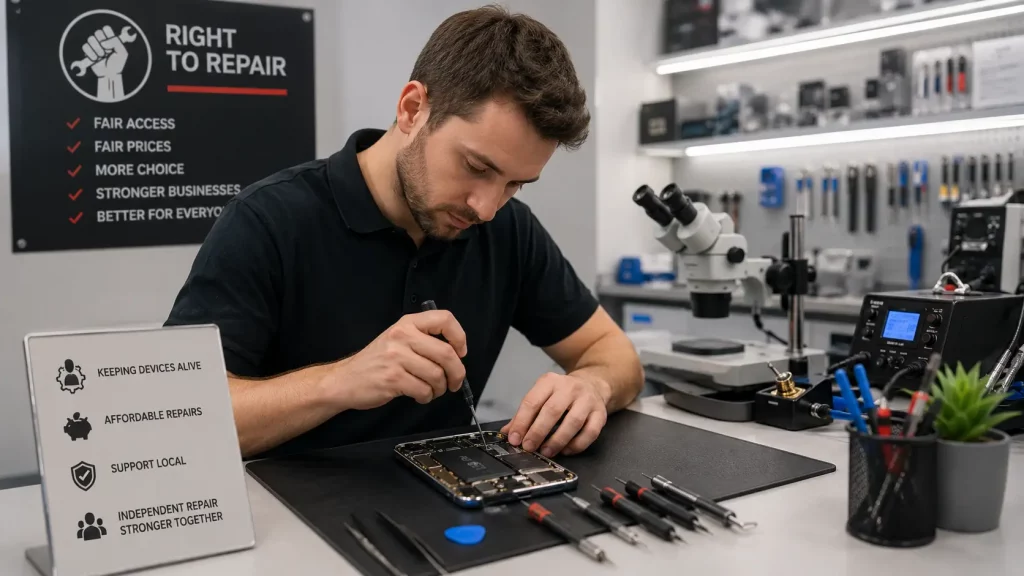
Parts availability has already improved. Apple expanded its Self Service Repair programme. Samsung made more components available to independent shops. Other manufacturers have followed, sometimes voluntarily and sometimes because the incoming legislation left them little choice.
But the biggest change is cultural, not legal. The conversation has shifted. Five years ago, taking your phone to an independent repair shop carried a stigma. People worried about voiding their warranty or getting inferior parts. Now, right to repair is mainstream. Consumers understand that they have the right to choose where their phone is repaired, and the law increasingly backs that up.
At Phone Clinic, we have always operated on the principle that your phone is yours to fix wherever you choose. The law is catching up to what independent repair shops have been saying for years: you should not have to pay manufacturer prices for every repair, and you should not lose features because you chose a different shop.
What This Means for You as a Phone Owner
Here is the practical summary of what the right to repair laws mean for your daily life.
Your phone is now designed to last longer. Manufacturers know that parts and updates must be available for years after launch. This creates an incentive to build phones that are more durable and more repairable from the start.
You have more repair options. Independent shops now have better access to parts and technical information. This means more competition, which generally means lower prices and faster service.
Your warranty is not automatically voided by independent repair. Under UK consumer law, a manufacturer cannot refuse warranty coverage for an unrelated fault simply because you had a different part of the phone repaired by an independent shop. They can only refuse if they can prove the third party repair caused the specific fault in question. The right to repair laws reinforce this principle.
You can keep your phone longer before upgrading. With guaranteed software updates for five years and parts availability for seven, the pressure to upgrade every two or three years is reduced. A repair that costs a fraction of a new phone keeps a working device in your hands for longer.
How Phone Clinic Fits Into the Picture
We repair phones, tablets, and laptops across 14 UK stores. We have been doing this since 2015, long before right to repair became a legal framework.
The principles behind the legislation are the same ones we have always followed. Fair pricing. Transparent quotes before any work starts. Quality replacement parts. A warranty on every repair. And a no fix, no fee policy that means you never pay for a repair that does not work.
The right to repair laws validate what the independent repair industry has been doing for years. We welcome them. We also hope they continue to improve, especially when it comes to capping parts prices and extending consumer access to repair information.
If your phone needs fixing, you do not need to wait for the law to make it easier. We are already here.
Frequently Asked Questions
Does the UK right to repair law cover smartphones?
Yes. Since 20 June 2025, the UK’s updated Ecodesign regulations cover smartphones and tablets. Manufacturers must supply spare parts for seven years after a device launches, provide software security updates for five years, and share repair manuals and diagnostic tools with professional repair businesses.
Does the EU Right to Repair Directive apply in the UK?
The EU Directive does not directly apply in the UK because the UK is no longer an EU member state. However, UK consumers benefit indirectly because manufacturers design their devices to comply with EU requirements, and those same devices are sold in the UK. Northern Ireland may be directly affected under the Windsor Framework, though the details are still being clarified.
Can a manufacturer void my warranty if I use an independent repair shop?
Under UK consumer law, a manufacturer cannot automatically void your entire warranty because you used an independent repairer. They can only refuse warranty coverage for a specific fault if they can prove the independent repair directly caused that fault. They cannot refuse a warranty claim for an unrelated issue.
Will right to repair make phone repairs cheaper?
It should help. Better parts access and more competition among repairers generally pushes prices down. However, the UK law does not cap the price manufacturers can charge for spare parts, so the impact depends on how manufacturers choose to price their components.
What is parts pairing and is it now banned?
Parts pairing is when a phone’s software detects a non original component and displays warnings or disables certain features. The EU Right to Repair Directive bans this practice in member states from July 2026. The UK’s regulations do not explicitly ban parts pairing in the same way, but the trend among manufacturers is moving away from it as regulatory pressure increases globally.