
You know what? I spent twenty solid minutes yesterday hunting for a specific email just so I could copy a confirmation number, paste it into a rideshare app, and figure out exactly when I needed to leave for a concert. It was tedious. Honestly, we accept this kind of friction because it is how phones have always worked.
But here is the thing. That era is officially dead.
Welcome to the reality of Agentic AI smartphones 2026. Your phone is no longer a passive piece of glass waiting for you to tap an icon. It is an active participant in your day. We have moved way past the gimmick of asking a chatbot to write a funny poem or generate a quirky image. The new wave of devices features a built-in AI phone assistant that actually gets things done for you.
Let me walk you through exactly why this year’s hardware makes everything you owned in 2024 look like a rotary dial.
The End of the Reactive Era
Let me explain how we got here. For the last few years, we relied on reactive AI. You ask a question, you get an answer. You press a button, it erases a photobomber from your selfie. That is cool, sure. But it still requires you to be the busy manager of your digital life.
An autonomous AI mobile device flips the script entirely. Instead of waiting for a prompt, it anticipates your intent.
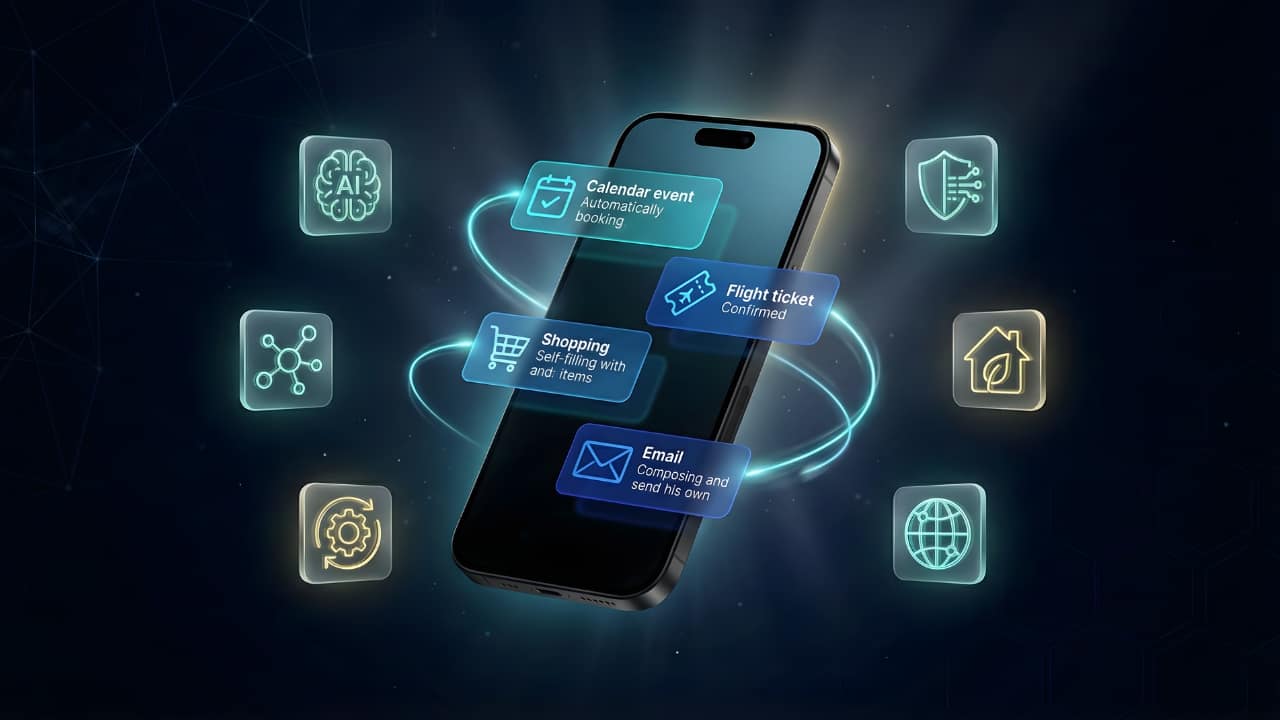
Imagine this. Your phone sees a calendar invite for a flight. It automatically cross-references real-time traffic, checks your typical morning routine, and quietly suggests a precise departure time. It even pre-books the ride if you permit it. You never opened a single app. The AI essentially becomes the operating system itself. It functions as an invisible AI super app, hiding right beneath the surface of your screen, connecting the dots so you do not have to.
The Muscle Behind the Magic
You might be wondering how a phone handles all this brainpower without instantly catching fire.
The secret lies entirely in the silicon. Up until recently, most heavy AI tasks had to be sent off to a massive server farm in the cloud. That caused lag. It also raised some pretty valid privacy concerns. Now? The brains live directly in your pocket.
Tech giants are now using Small Language Models (SLMs) that run locally on the device. This shift is massive. When a smartphone AI agent processes your personal data, your texts, your health metrics, your banking info- it never leaves the physical hardware. Zero latency. Total privacy. A tiny silicon brain handles the heavy lifting, keeping your data safe. The processors driving this, like the new Snapdragon 8 Elite Gen 5 or the Apple A19, are absolute beasts. They handle complex reasoning instantly.
Vision Over Voice
We are so used to talking to our phones or typing out requests. That is changing fast. The most impressive feature of Agentic AI smartphones 2026 is how they use their cameras. Multimodal input, meaning the AI understands text, voice, and vision simultaneously, is the new standard.
Say your expensive espresso machine starts making a weird, aggressive grinding noise. You do not type “why is my Breville machine making a loud noise” into a search engine anymore. You just point your camera at it.
The AI recognizes the exact make and model, listens to the sound profile, and diagnoses a jammed pump. Then, it overlays an augmented reality arrow right on your screen, showing you exactly which screw to turn. It feels like science fiction. But it is happening right now in our hands.
The Heavyweights: Best AI Phones 2026
So, who is actually leading the pack? If you are looking to upgrade, the playing field is fiercely competitive right now. Here are the top contenders redefining the mobile landscape:
- Google Pixel 10 Pro XL: This is arguably the smartest device on the market today. Powered by the Tensor G5 chip (built on a flawless 3nm process), it runs Gemini Live 2.0 effortlessly. Google integrated the AI so deeply that the interface actively changes based on your context. In the morning, it highlights your commute and unread emails. By evening, it shifts automatically to your smart home controls and media.
- Samsung Galaxy S26 Ultra: Samsung took the sheer hardware route. They paired a massive 5000mAh battery with incredibly fast on-device processing. The standout feature is Cross-App Actions. You can tell it to “find the best sushi spot near my hotel and text the address to Sarah.” The phone executes the entire sequence across Maps, Search, and Messages seamlessly.
- Apple iPhone 17 Pro Max: Apple always plays the long game. The A19 chip powers a deeply refined iOS 26 experience. The new Liquid Glass interface feels fluid, adapting to your habits without being visually intrusive. Features like Live Translation happen instantly, completely offline.
The Battery Paradox
Now, here is a bit of a contradiction. You would assume that running a highly advanced, always-thinking AI phone assistant 24/7 would absolutely wreck your battery life.
I thought the same exact thing. But the opposite is actually true.
These phones use their intelligence to aggressively manage power distribution. They learn your specific habits. If you never check your email between 1 AM and 6 AM, the phone puts those background processes into a deep sleep. They adjust screen refresh rates dynamically based on what you are looking at. Paired with the new high-density silicon-carbon batteries, devices like the OnePlus 15 and Xiaomi 16 Ultra easily push past a full day of heavy use.
The Catch (Because There Is Always One)
Is it all sunshine and effortless productivity? Not quite.
The biggest hurdle we face right now is trust. When autonomous AI mobile agents have the power to execute tasks, they need access to everything. Your passwords, your personal contacts, your payment methods.
Cybersecurity experts are already waving red flags about the risks. If a bad actor gains access to your phone’s AI agent, they do not just steal data; they can execute commands. The tech companies are fighting this by making privacy a physical hardware feature. They use dedicated neural processing units that isolate sensitive tasks entirely from the main system. Still, handing over the keys to your digital life requires a real leap of faith.
We are standing at a weird, thrilling crossroads. Those static grids of colorful app icons are starting to look like relics of the past. Agentic AI smartphones 2026 are not just communication devices anymore. They are active digital proxies. They think, they plan, and they act.
Whether you grab the sleek iPhone 17 or the powerhouse Galaxy S26 Ultra, the core experience is fundamentally different. Your phone is finally becoming the intelligent companion we were promised a decade ago.
Frequently Asked Questions (FAQ)
Q: What is the difference between Agentic AI and Generative AI on smartphones?
A: While generative AI is designed to create content, like drafting an email or generating an image, Agentic AI acts autonomously to execute tasks. In 2026, smartphones will have a smartphone AI agent that can perform multi-step workflows, such as reading a meeting invite, checking live traffic, and automatically booking a rideshare, all without you manually opening a single app.
Q: Which are the best AI phones coming out in 2026?
A: The leading Agentic AI smartphones in 2026 include the Samsung Galaxy S26 Ultra, which features robust cross-app action capabilities; the Google Pixel 10 Pro, powered by the ultra-efficient Tensor G5 chip and Gemini Live 2.0; and the Apple iPhone 17 Pro Max, which utilizes the A19 Pro processor to run complex, on-device intelligence seamlessly within iOS 26.
Q: Will an autonomous AI mobile assistant drain my battery faster?
A: Surprisingly, no. The processors driving 2026 devices are built specifically for “edge AI,” meaning they process data locally using dedicated Neural Processing Units (NPUs). These AI phone assistants actually improve battery life by learning your daily habits, predicting your app usage, and aggressively putting unused background processes into deep sleep.
Q: Are Agentic AI smartphones secure with my personal data?
A: Yes, privacy is a major hardware focus for this new generation of devices. Because autonomous agents need access to your calendar, emails, and payment methods to function as an AI super app, manufacturers now use Small Language Models (SLMs) that process your information locally. This means your sensitive data is handled entirely on the device itself and is not sent to external cloud servers.
Q: Can I turn off the AI agent on my 2026 smartphone?
A: Yes. While Agentic AI is deeply integrated into the operating systems of the newest models, manufacturers provide granular controls. You can restrict the AI’s access to specific apps, disable autonomous actions, or turn off the assistant features entirely through the device’s privacy settings.